
Intel Finally Admitted What Everybody Should Already Know: Moore's Law is Broken
How a single off-script comment at Computex exposes the structural crisis threatening the economics of AI

“What Has Been Said Can’t Be Unsaid”
A few days ago, Nish Neelalojanan, Intel’s senior director of product management for Client Computing Group, said at Computex 2026 in Taiwan something that everybody knows, but then went further and dropped a truth bomb.
The quotes:
“DDR5 RAM prices are ‘out of control’.”
“Longer term, I think something has to give, right? The [memory] over-inflation, we will have to keep an eye out.”
“But if I could predict the memory market, I would be rich in stock.”
It wasn’t a product roadmap. It was an admission. The kind that slips out when the talking points stop working.
And then:
“We do have products that support DDR4 on both desktop and mobile. Raptor Lake, we’re not end-of-life-ing any of them; they’re there. We’ll continue to make sure that there are products which can take care of older memory technologies if they’re available and cheap.”
“Second thing is, we are making sure we are validating lower configs for Wildcat Lake as well. Wildcat Lake starts at 8GB. Wildcat Lake is a single-channel product, so there are products which can leverage low memory and give reasonably good performance.”
In the context of a keynote designed to project confidence, those remarks were extraordinary. They laid bare what the industry has been papering over for nearly two years: the economics of personal and professional computing are moving in the wrong direction, and nobody at the top of the stack has a clean solution. To be fair, Nvidia CEO Jensen Huang, along with partners, has a plan. But nothing has been delivered yet.
Moore’s Law Was Never Really Only About Transistors
Gordon Moore’s 1965 observation, that transistor density on a chip doubles roughly every two years, became the foundational myth of the digital economy. But in practice, what the industry operationalized wasn’t transistor mechanics. It was cost. What became known as Moore’s Law was an economic rule: every two years, computing power per dollar doubles.
Memory gets cheaper. Storage gets cheaper. Everything downstream, software, services, AI, is built upon the assumption that the infrastructure will always cost less next cycle than it does today. This assumption underpinned everything. It’s why software could become bloated and still be tolerated. It’s why startups could train machine learning models on rented cloud compute. It’s why Moore’s Law became shorthand not for semiconductor physics but for a civilizational expectation: technology democratizes itself over time.
This expectation is now structurally broken. And memory is where it broke first.
How AI Broke Moore’s Law Logic
The main cause of the DDR5 “over-inflation” crisis, to use Intel’s director’s own words, is straightforward: the three companies that control roughly 95% of global DRAM production, Samsung, SK Hynix, and Micron, redirected their leading-edge fabrication capacity toward High Bandwidth Memory (HBM) for AI accelerators. At the same time, hyperscale cloud providers locked up virtually all remaining capacity through long-term exclusive contracts. Consumer DDR5, drawing from a different die density tier and a demand base with high price elasticity, was left exposed to a supply environment that had been deliberately constrained at the top.
The result was not a temporary price spike. It was what one analysis termed a “regime change”: 64GB DDR5 ECC RDIMM modules tripled in street price in late 2025, and the oligopolistic production discipline of the three major DRAM manufacturers produces no incentive for any of them to flood supply at a moment of peak pricing power. The free market worked exactly as designed. And the consumer is paying the steepest price.
This is the structural trap. HBM is not consumer memory. It is physically incompatible with desktop and laptop sockets. The two markets share fab capacity and engineering talent but serve entirely different demand pools. When AI hyperscalers outbid the rest of the world for leading-edge DRAM capacity, everyone else fights over what’s left. And what’s left is getting more expensive.
The Only Short-Term Move Left: Recycle Old Components
The most telling indicators of the crisis are not the price tags, but the product decisions.
Intel has confirmed that DDR4, a memory standard introduced in 2014, will not receive an End of Life designation and will be supported indefinitely. This is presented as a practical move for the market. It is also an admission that a non-trivial share of Intel’s customer base cannot justify the cost of upgrading to DDR5, a standard that was supposed to be DDR4’s successor, not its permanent coexistence partner. Meanwhile, Wildcat Lake, Intel’s upcoming mobile platform, is being validated down to 8GB single-channel configurations, a memory footprint more associated with entry-level devices from a decade ago than with a current-generation laptop platform.
(Personal example: just last September I bought 256GB of DDR5 for under $1,000.)
AMD’s rumored decision to bring the Ryzen 5800X3D back to market is equally instructive. The 5800X3D, launched in 2022, used 3D V-Cache stacking as an architectural bridge, a clever performance hack designed to hold the line while a more comprehensive next-generation platform arrived. The re-release signals that the “more comprehensive next-generation platform,” when paired with DDR5 memory at current prices, does not represent a compelling upgrade for a substantial portion of the market. The bridge has become the destination.
(That DDR5 I mentioned above pairs with an AMD 9950X3D. Make of that what you will.)
These are not isolated product decisions. They form a coherent picture: an industry engineering backwards compatibility as a survival strategy, because the forward path has become unaffordable.
Memory Is a Binding Constraint on AI and the Whole Economy
The implications extend well beyond consumer PC pricing. Memory bandwidth and capacity are now recognized, alongside energy costs, as the primary bottlenecks for AI model training and inference at scale.
Training frontier large language models requires enormous memory capacity. DeepSeek-V3, trained on 2,048 NVIDIA H800 GPUs, was architecturally redesigned, introducing Multi-head Latent Attention, Mixture of Experts configurations, and FP8 mixed-precision training, specifically to work around memory constraints. The engineering was not primarily about computation. It was about the fact that memory was the binding resource, and the model had to be co-designed with that constraint in mind.
The broader academic literature is explicit on this point. A 2025 framework describing the “AI Trinity”, computation, bandwidth, and memory as coequal pillars of AI infrastructure, notes that these dimensions are tightly interconnected, so improvements in one create bottlenecks in others. Current DRAM technologies, including HBM with die stacking, are described in peer-reviewed work as “insufficient” for training models at trillion-parameter scale. The path forward, 3D-stacked DRAM, co-packaged optics, CXL-attached memory, is technically viable but commercially years away from mainstream deployment.
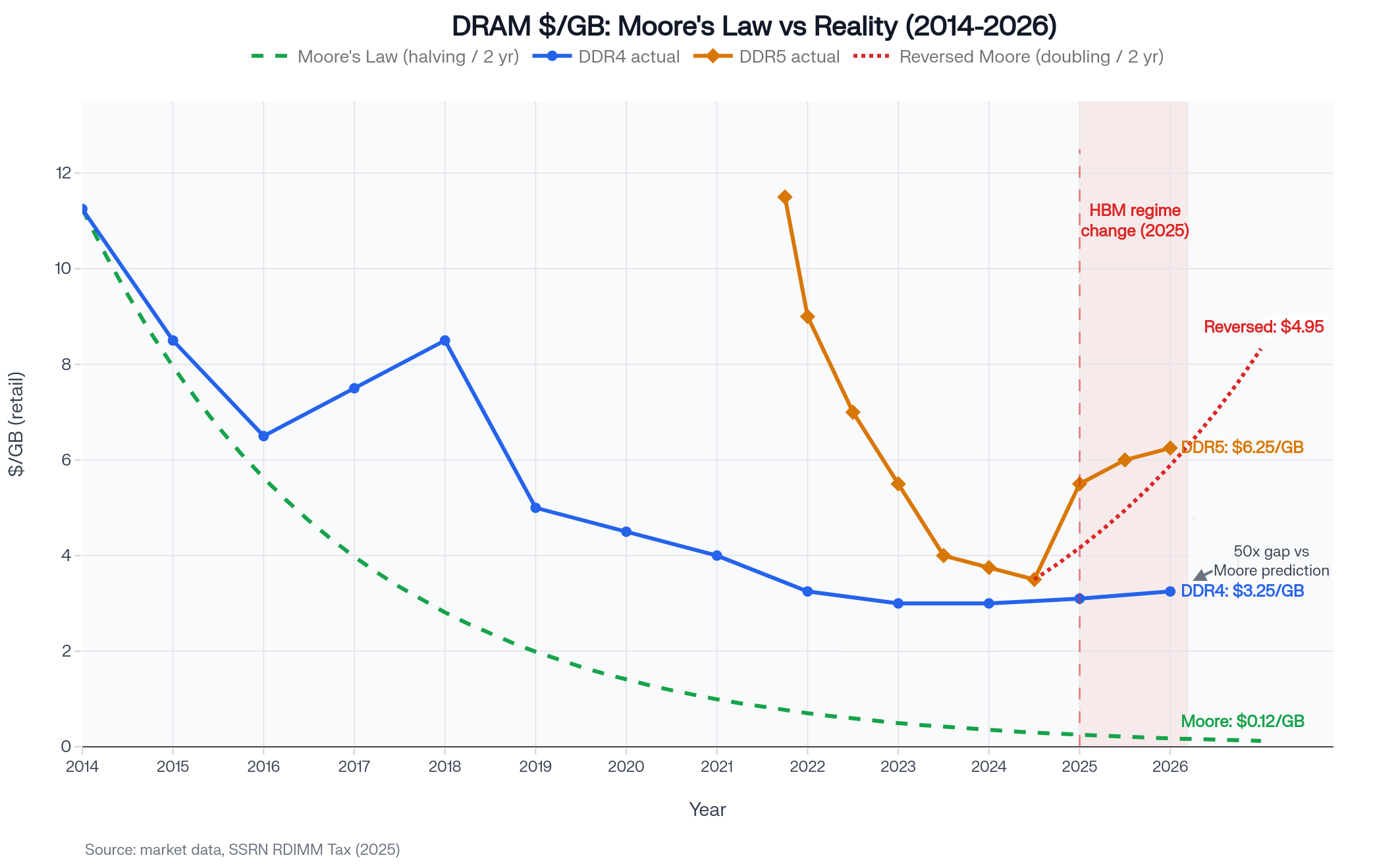
The chart below illustrates Moore’s Law from 2014 to 2026, pointing the strucutral breakpoint. The current prices for DDR4 and DDR5 and the projetion for Moore’s Law running in reverse paint a troubling picture.
The Centralization Trap
Here is the feedback loop that the industry is reluctant to name directly:
The AI boom created extraordinary demand for HBM. DRAM manufacturers reallocated fab capacity to meet that demand at premium prices. This constrained consumer DDR5 supply and drove prices up. Higher memory prices increase the cost of AI infrastructure. Higher AI infrastructure costs concentrate frontier model training in the hands of a small number of entities: those with the capital to sign long-term capacity contracts with fabs or to fund their own silicon, Google TPUs, Amazon Trainium, Microsoft Maia. Everyone else pays spot prices.
The result is a structural aristocratization of compute. Moore’s Law gave the industry democratized infrastructure. The current regime does the opposite: the larger the buyer, the cheaper the memory per bit; the smaller the buyer, the more expensive every component of the stack becomes.
What “Something Has to Give” Actually Means
Intel’s director chose careful language. “Something has to give” is not a prediction. It is a pressure acknowledgment. The scenarios in which pressure resolves are limited:
Memory prices fall. This requires cartel discipline to break, historically rare in DRAM, an industry with a well-documented history of price coordination. It would also require AI demand to plateau, reducing the premium HBM commands and freeing fab capacity for consumer-grade memory. Neither is imminent.
Alternative architectures absorb the bottleneck. CXL-attached memory, 3D-stacked DRAM, and co-packaged optical interconnects are all active research and commercialization vectors. These technologies can expand effective memory capacity without requiring more conventional DRAM. But mainstream deployment timelines are measured in years, not quarters.
Scarcity as a Motor of Innovation: or Why DeepSeek Put the Monster Under the Bed, Even if Only for a Few Nights
Before accepting that memory constraints doom AI progress, there is a counterargument worth taking seriously. Because it comes with receipts.
DeepSeek-V3, a Chinese model developed under US export controls that blocked access to the most advanced chips, matched or exceeded American frontier models on several benchmarks. Its engineers could not simply throw more memory at the problem. They had to think: about attention mechanisms, about sparsity, about what a model actually needs to do versus what it has been habitually given. The result was Multi-head Latent Attention, Mixture of Experts, FP8 mixed-precision training. Leaner. Faster. Cheaper to run. Its release was a shock so large that it sent the stock market into a brief tailspin.
This is the Soviet space program argument: resource scarcity forces solutions that abundance would never have found. The Americans had more money. The Soviets had better engineering discipline. Sound familiar?
But the argument cuts both ways. DeepSeek still required a team of world-class researchers, months of intensive work, and 2,048 H800 GPUs, the best chips they were still allowed to import. The barrier to entry did not disappear. It shifted: from “you need capital to buy memory” to “you need exceptional human capital to optimize without it.”
That is a different form of exclusion. Harder to see. Harder to contest. And in some ways more insidious, because it looks like meritocracy.
Is American AI Actually Intelligent?
Which brings us to the question nobody in the US AI industry wants to answer in public.
If a system requires hundreds of thousands of GPUs, gigawatts of electricity, and a structural reallocation of global memory supply just to function, is that intelligence? Or is it something else?
The honest description of what large-scale American AI actually does is not reasoning. It is high-dimensional pattern interpolation over vast memorized corpora. The “intelligence” is largely retrieval: extraordinarily fast, extraordinarily expensive retrieval, dressed in fluent prose. These are not systems that understand the world. They are systems that have seen most of the documented world and learned to predict what comes next in a sentence with uncanny accuracy. Don’t take my word for it. Go to YouTube and find any recent interview with @ylecun. If you’re reading this, you know who he is.
The architectural signature of this approach is not a tight reasoning engine. It is a resource-eating monster: memory-hungry by design, energy-hungry by necessity, scaling both dimensions faster than the infrastructure economics underneath it can follow. This is the system that broke the memory market. This is the system that forced Intel’s director to admit, at the world’s largest hardware conference, that prices are out of control. The machine that was supposed to represent the apex of human ingenuity is, in practice, the thing destroying the economic conditions that made computing democratic in the first place.
DeepSeek did not cause uproar because it was richer. It caused uproar because it was smarter about the problem. That distinction matters more than the industry is currently willing to admit, because it raises a harder question than “can we fix memory prices?”
It raises the question of whether the dominant paradigm of American AI is a dead end dressed up as a project to lead humanity to Carl Sagan’s Information Mastery Scale Class Z.
(Last personal note: I use a lot of US AI. But the bill is becoming unreasonable for two reasons: too much money, and increasingly mediocre results. So I priced out a server-class machine capable of running top-tier open-source models, Qwen, Kimi, GLM, see the pattern, using AMD Threadripper 64-core, 384GB RDDR5, two RTX 5090s, two PCIe 5 NVMes at 8TB each. To my surprise the total sits only 45% above my current rig, partly because I already have one RTX 5090 and the NVMes, and can sell my DDR5 at 60% of the replacement cost. The problem: the RDDR5 is nowhere to be found. The article proves itself.)
Coming Next: The Architecture of Brute Force
I’m planning to write about why American AI chose scale over efficiency, and what that decision reveals about the difference between engineering culture and engineering intelligence. We will look at the historical and economic incentives that made “throw more compute at it” the default solution, why that choice made sense in 2018 but may be structurally broken in 2026, and whether the DeepSeek moment is an anomaly to be dismissed or a preview of the paradigm that comes next.
The short version: the most powerful tool in human history was built to be as wasteful as possible. That wasn’t an accident.
Until then, Carpe Diem!
Femi, thanks for the excellent write-up. I´m firmly in the "something has to give" camp.