Absolute Resolve, abysmal Uncertainty
AI aided analysis of US invasion of Venezuela

Operation Absolute Resolve represents the most significant U.S. military intervention in Latin America since the 1989 Panama invasion. At approximately 10:46 PM ET on January 2, 2026, President Trump authorized over 150 aircraft from 20 Western Hemisphere bases to launch coordinated strikes on Venezuelan military infrastructure in Caracas. Delta Force operators successfully extracted President Nicolás Maduro and his wife Cilia Flores, who have now arrived in New York to face narco-terrorism charges in the Southern District of New York.
The operation achieved its tactical objectives with no U.S. fatalities and minimal equipment losses, but has triggered a geopolitical shockwave with profound implications for international law, regional stability, energy markets, and the U.S.-China strategic competition in the Western Hemisphere.
OPERATION ABSOLUTE RESOLVE: FACTS AND UNCERTAINTIES
Five Highest-Confidence, Highest-Impact Findings:
U.S. Operational Success Achieved (Confidence: 5 — CERTAIN): Maduro is confirmed in U.S. custody, having been transferred via USS Iwo Jima to New York. The 2020 indictment for narco-terrorism provides the legal basis for prosecution.
International Legal Order Under Severe Strain (Confidence: 5 — CERTAIN): The UN Secretary-General has declared the action a “dangerous precedent.” A UN Security Council emergency meeting is scheduled for January 5, with Russia, China, Colombia, and Brazil demanding urgent deliberation.
Oil Market Impact Likely Muted Short-Term (Confidence: 4 — HIGHLY LIKELY): Despite Venezuela’s 303 billion barrels in reserves (world’s largest), current production of only ~1 million bpd represents just 0.8% of global supply. Analysts project Brent crude may spike $1-5 initially but face downward pressure mid-term if restoration plans materialize.
Great Power Containment Strategy Evident (Confidence: 4 — HIGHLY LIKELY): The operation severs China’s primary Latin American oil-for-debt arrangement and signals assertive Monroe Doctrine enforcement, with Trump explicitly threatening Cuba as a potential next target.
Political Succession Highly Uncertain (Confidence: 2 — POSSIBLE): VP Delcy Rodríguez has reportedly been sworn in as acting president, but contradictory statements exist. Opposition leader María Corina Machado (2025 Nobel Peace laureate) calls for recognition of Edmundo González. U.S. has declared it will “run” Venezuela during transition.
Key Uncertainties
The following factors most significantly affect analytical reliability and should be monitored for rapid reassessment:
Transition of Power:
Governance transition mechanics undefined; Trump says U.S. will "run Venezuela" without specifying duration or mechanisms;
VP Delcy Rodriguez claims Maduro is still "president"; Trump claims she agreed to work with U.S. (Rodriguez denies);
María Corina Machado, 2025 Nobel Peace laureate, disqualified from 2024 election. Called for recognition of Edmundo González Urrutia as legitimate president based on contested July 2024 election results. Had previously stated she would "welcome more and more pressure so that Maduro understands he has to go."
Opposition seeks recognition of Edmundo González; no unified opposition leadership established Succession timeline: months to years; political legitimacy contested across Venezuelan factions;
Diosdado Cabello (Interior Minister), Most powerful figure in Chavista military/political structure besides Maduro. His response will determine whether armed resistance materializes.
Military-Strategic:
Extent of Venezuelan military resistance and potential for guerrilla warfare or urban insurgency
Whether Interior Minister Diosdado Cabello or military factions organize armed opposition
Scope and duration of U.S. military presence beyond the initial extraction operation
Political-Diplomatic:
Chinese response intensity and potential countermeasures regarding $60B+ Venezuelan debt holdings
Russian capacity and willingness to provide meaningful support given Ukraine commitments
U.S. congressional backlash and potential legal challenges under War Powers Resolution
Economic-Energy:
Extent of infrastructure damage to PDVSA facilities and restoration timeline
OPEC+ response and whether Saudi Arabia increases production to offset disruption
Speed of Western oil company deployment and capital commitment to Orinoco Belt recovery
STRATEGIC MOTIVATIONS
The intervention synthesizes multiple strategic imperatives that align with classical realist doctrine:
Primary Motivation — Energy Security (Confidence: 4 — HIGHLY LIKELY): Trump’s explicit statement that U.S. oil companies will “go in, spend billions of dollars, fix the badly broken infrastructure” confirms energy as a central objective. Venezuelan reserves could offset 10-15% of U.S. imports and provide critical heavy, sour crude essential for diesel and jet fuel production. PDVSA estimates $58 billion is required to restore infrastructure to enable a return to 1990s peak production of 3+ million bpd.
Secondary Motivation — Counter-Narcotics/Legal Pretext (Confidence: 5 — CERTAIN): The 2020 SDNY indictment for narco-terrorism conspiracy provides legal justification, with Attorney General Pam Bondi emphasizing the “state-sponsored gangs” and drug trafficking charges. The $50 million bounty on Maduro (increased from $15M during Biden administration) established precedent. This mirrors the 1989 Panama/Noriega operation almost exactly — drug charges as legitimate-but-convenient legal framework for regime change.
Tertiary Motivation — Domestic Political Consolidation (Confidence: 3 — LIKELY): The “rally around the flag” effect benefits the Trump administration, with Republican lawmakers largely applauding the action while Democrats criticize lack of congressional authorization. Defense Secretary Hegseth’s statement that Maduro “effed around and found out” signals the domestic political framing as “America First” strength projection.
Geostrategic Objective — Chinese/Russian Containment (Confidence: 4 — HIGHLY LIKELY): Venezuela represented China’s largest oil-for-debt partner in Latin America, with approximately $60 billion in outstanding loans. The operation severs this critical supply chain and signals willingness to enforce Monroe Doctrine principles. Trump’s hint that “Cuba could be next” reinforces regional hegemonic intent consistent with Brzezinski’s “grand chessboard” framework.
Historical Precedent Assessment
The 1989 Panama invasion (Operation Just Cause) provides the most direct analogue:
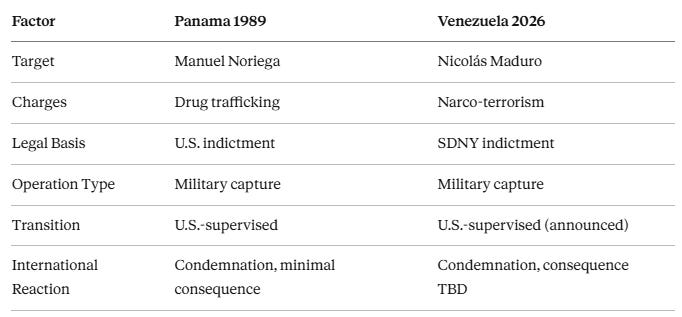
Key differences: Venezuela possesses the world’s largest oil reserves and sits within active Chinese/Russian sphere-of-influence competition — factors that amplify second-order consequences beyond Panama precedent.
INTERNATIONAL RESPONSE
Russian Position (Realist Framework — Lavrov Strategic Patience)
Russia’s Foreign Ministry condemned the strikes as “an act of armed aggression” constituting a “grave violation of sovereignty and international law.” Moscow called for an urgent UN Security Council meeting and stated Venezuela “must be guaranteed the right to determine its own destiny without any destructive, let alone military, interference from outside.”
Assessment (Confidence: 4 — HIGHLY LIKELY): Russia will provide rhetorical and diplomatic support but lacks capacity for meaningful military intervention given Ukraine commitments consuming operational resources. Proxy support through intelligence sharing or asymmetric means remains possible but limited.
Chinese Position (Wang Yi Strategic Ambiguity Framework)
China’s Foreign Ministry expressed being “deeply shocked” and “strongly condemns the U.S. for recklessly using force against a sovereign state.” Beijing stated the action “seriously violates international law, violates Venezuela’s sovereignty, and threatens peace and security in Latin America and the Caribbean.”
Assessment (Confidence: 3 — LIKELY): China faces significant financial exposure ($60B+ in Venezuelan debt) but lacks regional military capability for direct intervention. Response likely confined to diplomatic pressure, economic countermeasures in other theaters, and acceleration of alternative supply arrangements. The operation may accelerate Chinese recalculation regarding Taiwan contingencies — Senator Warner’s concern that this “sets a precedent” for sovereign intervention has validity.
THE PRECEDENT PARADOX: Tactical Success, Strategic Risk
The operation achieves near-perfect tactical execution (Maduro captured, minimal casualties, infrastructure preserved) while establishing a dangerous international precedent. By demonstrating willingness to conduct unilateral regime change operations without UN mandate or Congressional authorization, the U.S. creates legal framework that China may cite for Taiwan military action.
Strategic Implications Chain:
1. U.S. establishes right to unilateral intervention against narcotics-linked regimes;
2. China observes precedent and prepares parallel justification for Taiwan;
3. Taiwan’s geopolitical risk premium expands; semiconductor supply chain (TSMC = 92% advanced fab capacity) faces elevated volatility;
4. Long-term market impacts potentially exceed Venezuela-specific oil/energy impacts.
Regional Latin American Responses
Brazil (Lula): Called for UN “vigorous response.” Brazil’s position reflects both ideological alignment with left-of-center governments and genuine concern about sovereignty principles.
Colombia (Petro): Condemned as “aggression against the sovereignty of Venezuela and of Latin America.” Deployed military forces to border anticipating refugee influx. Called for UN Security Council emergency meeting. Colombia hosts largest Venezuelan diaspora and faces immediate humanitarian consequences.
Argentina (Milei): Notably silent as of analysis time — reflecting ideological alignment with U.S. right but likely concern about precedent implications.
Regional Assessment: The intervention has potentially fractured regional solidarity, with left-leaning governments (Brazil, Colombia, Mexico, Cuba) opposing and right-leaning governments (Ecuador, Argentina potentially) either silent or supportive. The OAS and UNASUR frameworks are unlikely to generate unified response given ideological polarization.
OIL MARKETS: FUNDAMENTS PREVAIL
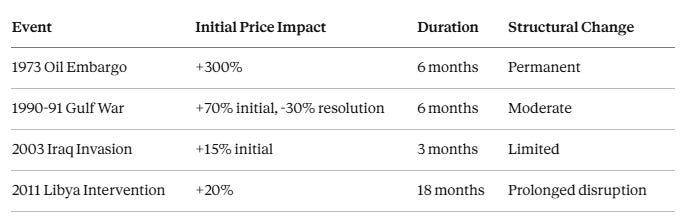
Contrary to historical precedent, oil price spike unlikely despite regime change in world's most oil-reserve-rich nation. Venezuela possesses 303 billion barrels of proven reserves — approximately 20% of global reserves and the world's largest. However, current production has collapsed to approximately 1 million bpd (down from 3.5 million pre-Chavez era) due to sanctions, mismanagement, and infrastructure decay.
The Math
Venezuelan current production: ~1 million bpd
Global supply: ~102-103 million bpd
Global demand: ~101-102 million bpd Venezuela share: 0.8% of global crude Even complete cessation = 0.98% global supply reduction (insufficient to overcome oversupply)
Venezuelan’s Reserves Characteristics
Primarily heavy, sour crude from Orinoco Belt
Essential for diesel and jet fuel production
Unique refining requirements limit substitutability
PDVSA estimates $58 billion required for infrastructure restoration to reach 3 million bpd
Historical Precedent Analysis
Oil Market Impact Projection
Immediate (Market Open — Sunday evening/Monday):
Brent crude likely to open $1-5 higher ($62-66 range) based on analyst projections
WTI futures similar trajectory
Gold may approach $4,380/oz COMEX (currently ~$4,345)
VIX expected to spike 15-25%
Risk-off sentiment favoring USD, treasuries
Short-Term (1 week):
Price action dominated by newsflow on infrastructure damage assessment
OPEC+ signaling on potential offsets critical
If no escalation, partial mean-reversion likely
Volatility elevated but potentially stabilizing
Medium-Term (1 month):
If U.S. presents credible restoration plan, bearish pressure may emerge
Medium-term outlook could be bearish if production revival prospects materialize
$58B infrastructure investment timeline creates multi-year recovery scenario
Structural oversupply in global markets limits sustained price elevation
Critical Analyst Perspectives:
Saul Kavonic (MST Financial) projects exports could approach 3 million bpd medium-term if sanctions lift and foreign investment returns — suggesting eventual bearish impact.
David Goldwyn (former State Dept.): “If anything, the future of Venezuela will have a bearish impact on the market, because there’s really nowhere to go but up.”
Bob McNally (Rapidan Energy): Approximately one-third of current Venezuelan production at risk, but global oversupply limits meaningful price impact.
Not investment advice. Analysis based on publicly available information and historical patterns. Past performance does not guarantee future results.
GENERAL MARKET IMPACTS
Potential Beneficiaries:
Defense Contractors (LMT, RTX, NOC, GD): Historical pattern shows defense stocks rally 5-15% on major military operations. Extended U.S. involvement would sustain positive momentum. Risk: Overvaluation if conflict concludes quickly.
Oilfield Services (SLB, HAL, BKR): These companies possess the technical capability required for Orinoco Belt restoration. Schlumberger and Halliburton likely first-movers if contracts materialize. Timeline: 6-24 months for meaningful revenue impact.
Major Integrated Oils (XOM, CVX, COP): All three had significant pre-nationalization Venezuelan assets ($15-20B, $10-15B, $8-12B inflation-adjusted respectively). Potential for asset recovery or new concession agreements. Chevron maintained limited operations under specific licenses — may have first-mover advantage.
Energy ETFs (XLE, XOP): Broad sector exposure with reduced single-stock risk. XLE captures majors; XOP captures E&P companies.
Potential Risks:
Emerging Market Exposure (EWZ, EM currencies): Latin American currency depreciation pressure (25% vs. USD) from regional instability and reduced policy autonomy;
Airlines/Tourism: Diesel/jet fuel exposure to Venezuelan heavy crude disruption; regional travel uncertainty.
Prolonged conflict likely to impact FIFA’s World Cup attendance.
Technology/Semiconductors (Tail Risk): Taiwan precedent effect creates geopolitical risk premium. TSMC supply concentration elevated. Companies (AAPL, QCOM, NVDA) with Taiwan supply dependency face 5-15% volatility increase absent explicit Taiwan security assurances.
Not investment advice. Analysis based on publicly available information and historical patterns. All investments involve risk of loss.
INTERNATIONAL LAW ANALYSIS
Legal Framework Assessment
U.S. Legal Position: The administration relies on a specific interpretation — because Washington did not recognize Maduro as legitimate president following the disputed 2024 elections, it views him not as a protected head of state but as an indicted fugitive leading a criminal enterprise. The 2020 SDNY indictment for narco-terrorism provides statutory basis. This mirrors the “Noriega precedent” and invokes the “Ker-Frisbie doctrine” — suggesting that once a defendant appears in U.S. court, the circumstances of capture do not invalidate jurisdiction.
International Legal Consensus: The overwhelming international reaction characterizes the action as a violation of UN Charter Article 2(4) prohibiting the use of force against territorial integrity. UN Secretary-General Guterres explicitly stated it constitutes a “dangerous precedent.” France’s Foreign Minister characterized it as a violation of international law, stating “no lasting political solution can be imposed from the outside.”
Implications:
The intervention establishes (or reinforces) precedent that the U.S. will unilaterally enforce regime change when it determines a government to be illegitimate or criminal, regardless of UN Security Council authorization. This creates significant second-order effects:
China/Taiwan calculus: The precedent that disputed elections can justify military intervention may be cited in other contexts
International rules-based order: The post-WWII framework explicitly designed to prevent unilateral military solutions to political disputes is significantly strained
U.S. credibility: Allies and adversaries alike will recalibrate assumptions about American willingness to act outside multilateral frameworks
SYNTHESIS & SCENARIOS
The most consequential aspect of Operation Absolute Resolve may not be its immediate market effects—which are likely contained due to global oversupply and Venezuela's minimal current production—but rather the normative precedent it establishes.
By demonstrating willingness to conduct regime change operations against oil-rich adversaries without Congressional authorization or UN mandate, the United States has created legal and diplomatic ammunition for rivals contemplating similar actions. China's calculus regarding Taiwan must now factor in reduced U.S. credibility to oppose unilateral military intervention.
With Taiwan producing 92% of advanced semiconductors and TSMC's U.S. diversification inadequate until end-of-decade, this precedent effect represents potentially the largest longterm market risk emerging from the Venezuela operation—one that warrants immediate reassessment of risk premiums across the semiconductor supply chain and technology sector.
Scenarios
Base Case (60% probability)
U.S. successfully transitions Venezuela to opposition government within 6-12 months. Limited armed resistance. Oil infrastructure restoration begins with Western investment. International condemnation fades without meaningful consequences (Panama model). Markets stabilize after initial volatility. Great powers confine response to rhetorical opposition.
Optimistic Case (20% probability)
Rapid, peaceful transition. Venezuelan military cooperates with U.S. administration. Opposition government achieves legitimacy. Oil production recovery accelerates. Regional relationships repair through diplomatic engagement. Democratic Venezuela becomes U.S. ally and energy partner.
Pessimistic Case (20% probability)
Protracted insurgency develops with Chavista military/paramilitary resistance. Urban warfare in Caracas. U.S. troop commitment escalates. Regional humanitarian crisis with mass refugee flows to Colombia, Brazil. China/Russia provide covert support to resistance. Oil infrastructure further damaged. Markets experience sustained volatility. Congressional backlash forces policy reversal.
METHODOLOGY NOTES
This analysis synthesizes multiple analytical frameworks:
Strategic: Realist doctrine (Kissinger balance-of-power, Brzezinski Eurasian pivot analysis) for great power dynamics; Liberal institutionalist framework (Guterres/UN multilateralism) for international law assessment.
Financial: Pattern recognition from 50+ years of geopolitical crisis market impacts including 1973 embargo, 1979 Iran, 1990-91 Gulf War, 2003 Iraq, 2011 Libya, 2014 Crimea, 2022 Ukraine.
Regional: Celso Amorim South-South diplomacy framework for Latin American assessment; Jaishankar strategic autonomy lens for emerging power responses.
Confidence levels follow standardized 1-5 scale:
5 — CERTAIN: Documented fact
4 — HIGHLY LIKELY: Strong evidence
3 — LIKELY: Moderate evidence
2 — POSSIBLE: Limited evidence
1 — SPECULATIVE: Logical possibility only
DISCLAIMERS
Market Analysis: Not investment advice. Analysis based on publicly available information and historical patterns. Past performance does not guarantee future results. All investments involve risk of loss.
Casualty/Damage Estimates: Methodology-based estimates. Actual figures require verified ground reporting and official disclosures.
Political Predictions: Assessment based on information available as of January 3, 2026, 8:00 PM EST. Situation remains highly fluid and subject to rapid change.
SOURCES
Primary (Tier 1-2):
CBS News live updates and official coverage
FOX News live updates
Foreign Policy analysis
CNN comprehensive coverage
ABC News live updates
PBS NewsHour coverage
Al Jazeera live blog and analysis
NPR regional reaction coverage
CNBC market analysis
Reuters wire service
Washington Post live updates
TIME international reaction analysis
Financial Analysis:
CNBC oil market expert interviews (Rasmussen, McNally, Kavonic, Goldwyn)
The National (UAE) energy market analysis
OilPrice.com supply analysis
Business Today analyst compilation
Bias Calibration:
State media (RT, Press TV) treated with appropriate skepticism
Partisan outlets (Fox, MSNBC) cross-verified
Venezuelan government statements (VTV) flagged as interested party